Goodwill Outlet vs. Liquidation Bin Store: What's the Difference?
A Goodwill Outlet sells regional, post-consumer donations by weight, typically $1.49–$2.19 per pound. A liquidation bin store sells retailer overstock and e-commerce returns on a daily descending flat-price model, starting around $10–$14 on restock day and falling to $1 or less by clearance day.
Below is a full breakdown of how each format sources, prices, and rotates inventory, plus how to choose the right one for your goals.

Goodwill Outlets source inventory from post-consumer donations that have already cycled through local thrift stores without selling. Items are priced by the pound ($1.49–$2.19/lb), which makes the format ideal for lightweight vintage clothing, antiques, and books.
Liquidation bin stores source directly from retailer return pipelines like Amazon, Walmart, Target and price everything at a flat descending rate that starts around $10–$14 on restock day and falls to $1 or less by clearance day. The bin store format is the stronger channel for electronics, tools, and brand-name goods.
Goodwill Outlets vs. Liquidation Bin Stores: The Quick Comparison
Goodwill Outlets and liquidation bin stores diverge across nearly every operational dimension, including inventory origin, pricing model, and physical floor environment. The table below maps those differences directly, drawing on our verified Goodwill Outlet locations directory alongside our nationwide database of liquidation bin stores.
| Category | Goodwill Outlet | Liquidation Bin Store |
|---|---|---|
| Inventory Origin | Post-consumer donations (regional) | Retailer overstock, shelf pulls & e-commerce returns |
| Supply Chain | Localized, closed-loop donation lifecycle | Global corporate e-commerce return pipeline |
| Pricing Model | Pay-by-the-pound ($1.49–$2.19/lb) | Daily descending flat price ($10–$14 → $1 or less) |
| Product Consistency | Highly variable; reflects local donation demographics | Variable, but skews consumer-electronics/home goods |
| Inventory Condition | Used, pre-owned; wear varies widely | Mix of new (shelf pulls/overstock) and open-box returns |
| Best Categories | Vintage clothing, antiques, books, glassware | Electronics, tools, toys, brand-name household goods |
| Shopping Atmosphere | Industrial warehouse; standardized rolling blue bins on metal frames, wheeled on/off the floor by staff | Retail storefront with improvised setups like wooden crates, folding tables, plywood panels, or tubs; layout varies by operator |
| Inventory Rotation | New bins every 15–30 minutes; ~64,000 lbs/day | Weekly pallet drop; floor cleared before each restock |
| Operated By | Goodwill Industries (non-profit regional chapters) | Independent operators purchasing wholesale pallets |
| Return Policy | As-is, no returns | As-is, no returns (strict enforcement) |
| Optimal Shopper | Vintage hunters, deal seekers, DIY crafters, antique collectors, resellers | Electronics shoppers, bargain hunters, discount seekers, general resellers |
| Online Auction Arm | ShopGoodwill (high-value items pulled upstream) | None; stock is physically floor-dumped |
Sourcing Channels and Supply Chains: Where the Inventory Comes From
Goodwill Outlets and liquidation bin stores draw from mutually exclusive supply chains, and that single fact explains nearly every other difference between the two formats. Inventory quality, product mix, and floor pace all trace back to which pipeline is feeding the bins.
At a Goodwill Outlet, you're digging through the tail end of local post-consumer donations of raw textiles, housewares, and the occasional estate-sale overflow. At a liquidation bin store, you're sorting through corporate e-commerce returns, which means a sharper eye for sealed boxes, model numbers, and barcode scanning pays off far more than a feel for fabric.
The Physical Floor Setup: Rolling Bins vs. Improvised Layouts
Goodwill Outlets run on a standardized fixture: large, waist-high rolling blue bins mounted on steel frames, which warehouse staff swap on and off the sales floor every 15 to 30 minutes to keep inventory moving. The blue bins themselves are uniform from Alabama to Oregon with the same branding, same dimensions, and same rotation logic.
Liquidation bin stores feature no equivalent industry presentation standard. Because independent operators manage these venues, every liquidation location improvises unique display systems utilizing wooden crates, folding tables, plywood structural dividers, or static plastic tubs stacked on pallets.
This structural variation creates a chaotic warehouse floor environment where sourcing intensity peaks on scheduled morning restock days rather than continuous hourly rotations. Resellers crowd the exterior staging lines prior to opening, meaning a durable pair of puncture-resistant gloves is mandatory to safely navigate the competitive morning merchandise rush.

The Goodwill Donation Lifecycle: What "Post-Consumer" Means
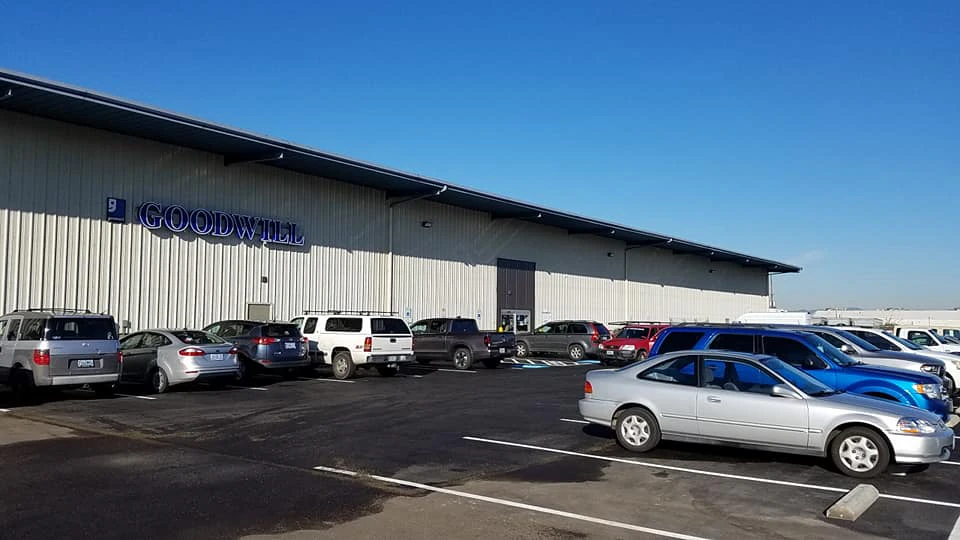
A Goodwill Outlet sits at the final retail stop in a multi-stage donation cycle, and that position determines what actually lands on the floor. By the time inventory reaches the Outlet, it has already been hand-sorted by staff, displayed on a regular thrift-store floor for up to five weeks, and marked down twice (50%, then 75%) without selling.
Goodwill is notably efficient at siphoning value before it ever reaches the Outlet floor. Nike, Coach, and KitchenAid pieces routinely get pulled upstream and listed on ShopGoodwill, where competitive bidding pushes prices well past what an Outlet shopper would pay by the pound.
What's left for the bins is the standard-grade remainder, consisting of high-volume, everyday goods that mirror local donation demographics. A wealthy suburb's Outlet skews toward designer cast-offs; a working-class neighborhood's skews toward mass-market basics.
Goodwill also runs specialized sub-channels for specific categories. GoodTech programs refurbish functional electronics for resale. Dell Reconnect partnerships handle safe disassembly and recycling of non-functional computer hardware. Textile recycling partners absorb the salvage that never sells at all: about 45% exported or resold into the used-clothing trade, 30% converted to industrial rags, and 20% processed into fiber insulation.
The E-Commerce Return Pipeline: How Amazon, Target, and Walmart Liquidations Work
Liquidation bin stores sit at the downstream end of a global corporate logistics problem. When a customer returns a product to an online retailer, the retailer runs into a cost equation: inspecting, cleaning, repackaging, and restocking that item frequently costs more than it can recover by reselling as certified-refurbished.
So the retailer writes it off, consolidates the returns into pallet lots, and sells those pallets to wholesale liquidators.
Three inventory classes flow through this pipeline: customer returns (opened or used, with condition all over the map), shelf pulls (unsold seasonal goods removed during inventory resets, usually still new in original packaging), and overstock (factory-fresh excess production or cancelled orders that never reached a shelf).
These pallets typically move through wholesale marketplaces like B-Stock and Liquidation.com before reaching an independent operator. Which mix you encounter in any given bin depends on which retailer the pallet came from, and whether the operator bought a manifested load (itemized) or an unmanifested one (a surprise box).
Independent vs. Franchise: The Reality of Bin Store Operations
Most liquidation bin stores run as small, family-owned operations with one or two people handling pallet sourcing, floor stocking, and checkout, with no national umbrella the way Goodwill operates. That ownership structure shapes the entire shopping experience, schedule and all.
Expect unpredictability. A delayed pallet shipment, a family emergency, or one sick employee can shut the doors for a day with zero notice, and stores have been known to skip a restock entirely and reopen mid-week without warning. Facebook and Instagram function as the de facto communication channel for most operators for restock announcements, pricing updates, sneak-peek unboxing clips, and closure notices nearly all run through social media first. Skip following the page and you'll miss the schedule change that actually mattered.
Store rules vary just as widely. Some post printed signage at the door; others rely on verbal announcements. Common policies include:
- Age restrictions: some stores bar children under 12 or 16 due to sharp packaging and crowded conditions.
- Restock-day queueing: numbered tickets or wristbands at some locations; pure first-come-first-served at others.
- Item limits: a per-customer cap on restock day to stop one buyer from clearing an entire electronics bin.
- No bags provided: same as Goodwill Outlets, bring your own.
- Limited amenities: converted warehouses and strip-mall storefronts rarely have restrooms, A/C, seating, or water fountains, and lighting can be poor.
- Cash-only or cash-preferred: smaller operators sometimes skip card processing fees entirely.
Pricing Models: Weight-Based Tiers vs. Daily Descending Flat Rates
Goodwill Outlets price every item by weight, while liquidation bin stores price every item on a daily descending flat scale. Getting the math right on either system, before your cart fills up, is what separates a real bargain from an accidental splurge.
Goodwill Outlets: Pay-by-the-Pound Mechanics
Pricing varies by regional Goodwill chapter, and every chapter offers bulk-discount tiers that reward high-volume buyers. The table below shows current verified pricing across four major outlet regions. Click any region to browse verified locations nearby.
| Region | Clothing & Textiles | Hardgoods / Wares | Books / Media | Bulk Discount |
|---|---|---|---|---|
| Canton & Cleveland, OH | $1.89/lb | $1.89/lb | $0.89/lb | $1.79/lb at 25+ lbs (clothing) |
| Austin, TX (North Outlet) | $2.19/lb | $2.19/lb | 4 books for $1.25 | Price drops after 10 lbs |
| Denver & Colorado Springs, CO | $1.99/lb (linen $0.49/lb) | $1.99/lb (utensils $0.79/lb) | $0.69 flat/unit | 10–25 lbs: $12 flat; 25+ lbs: $15 flat |
| Salt Lake City, UT | $1.99/lb (<25 lbs) $1.79/lb (25–99 lbs) $1.49/lb (100+ lbs) |
Same tiered rate | $0.99/lb (<25 lbs); $0.69/lb (100+ lbs) | Tiered rates apply to full transaction |
This weight-based model creates a sharp profitability gradient depending on what you're buying. Lightweight items are wildly profitable. For example, twenty silk blouses weighing a combined four pounds at $1.99/lb runs $7.96 total, roughly $0.40 per piece. Heavy items can flip negative fast: a cast iron skillet, a thick winter parka, or a stack of hardcover art books can blow your cost basis before you've even checked resale value.
Liquidation Bin Stores: The Weekly Descending Price Ladder

Liquidation bin stores reset on a weekly cycle. A fresh pallet drop, typically on Friday or Saturday, brings every item in the store to the same high flat rate regardless of its original retail value, and the price drops daily from there until the floor clears for the next shipment.
Timing here is a real strategic decision. Restock day costs more but gets you first access to the highest-value inventory; clearance day minimizes cost of goods but means most desirable items are already picked over. Experienced shoppers often run a two-visit strategy: a restock-day trip targeting specific high-value categories, then a mid-week or clearance visit for bulk low-margin volume.
Are Goodwill Bins Cheaper Than Amazon Bin Stores?
The honest answer depends entirely on what you're buying. For lightweight clothing and textiles, Goodwill Outlet bins win by a wide margin: a pound of vintage t-shirts at $1.99 holds five or six garments, each costing well under $0.40. Liquidation bin store items start at $10–$14 per item on restock day, and even clearance pricing at $1 is still per item, not per pound.
The math flips for heavy or high-value goods. A power drill at $4 on a Wednesday at a liquidation bin store is exceptional value; that same drill weighing 6 pounds at a Goodwill Outlet would run $11.94 at $1.99/lb, which is more than double, assuming it's even there.
Category-by-category buying guide:
- Vintage clothing, silk, cashmere, denim: Goodwill Outlet, every time
- Antiques, glassware, ceramics, books: Goodwill Outlet
- Consumer electronics, smart home devices: Liquidation bin store (restock day)
- Power tools, hardware: Liquidation bin store (restock or mid-week)
- Brand-name toys, games: Liquidation bin store
- Factory-sealed cosmetics, personal care: Liquidation bin store
- Furniture, heavy hardgoods: Neither, weight caps and bulk pricing make margins thin on both
Restock Cycles and Timing: When to Shop for Maximum ROI
Goodwill Outlets and liquidation bin stores run on entirely different clocks: Outlet shoppers track hourly bin rotations, while bin store shoppers track weekly restock days, clearance days, and social media updates. Those micro-timing cycles matter more than the calendar season for most sourcing trips.
Hourly Bin Rotations at Goodwill Clearance Centers
Goodwill Clearance Centers cycle fresh blue bins onto the floor throughout the day, often every 15 to 30 minutes at busier locations. The best finds usually surface in the first few minutes after a new row releases, though the rush for them is physical and competitive. If you're sourcing clothing, books, or small vintage hardgoods, learning the local rotation rhythm pays off more than picking a particular day of the week.
Weekly Restock Days vs. Clearance Days at Liquidation Outlets
Liquidation outlets follow a weekly descending price cycle in nearly every case. Restock day buys first access to electronics, tools, toys, and sealed merchandise at the highest price point; clearance day buys the lowest per-item cost on whatever's left. Resellers commonly hit restock day for targeted eBay or Amazon FBA inventory and save the mid-week days for lower-risk general merchandise.
Seasonal Sourcing Windows: Post-Holiday Returns and Prime Day Surges
Liquidation bin stores see three seasonal windows produce consistently heavier, higher-value loads, while Goodwill Outlet volume tracks donation events instead of retail cycles.
The Floor Experience: Etiquette, Warehouse Rules, and Safety
Goodwill Outlets and liquidation bin stores are both final-sale, as-is environments, but the safety risks, etiquette, and crowd behavior differ enough between them that a first trip to each deserves separate prep.
Goodwill Outlet Ground Rules: The Fresh Bin Rush and Floor Mapping
Goodwill Outlets are not regular thrift stores, and the unsorted nature of the bins is the reason why. Sharp glass, exposed metal edges, loose pins, fishhooks, and occasionally hypodermic needles turn up mixed in with clothing and housewares, which makes sturdy gloves non-negotiable if you're digging seriously. Bring hand sanitizer too, since bins get handled by hundreds of shoppers a day, and stores rarely supply hygiene basics.
Rules vary by location since each Goodwill region runs as an independent nonprofit chapter. Common policies include child restrictions, closed-toe shoe requirements, waiting for staff before touching fresh bins, limited cart availability, and no bags at checkout. Watch the regulars through one rotation before joining the rush, as the etiquette becomes predictable fast once you've seen how the floor is mapped.
Independent Bin Store Regulations: Unboxing Policies and Golden Rules
Independent liquidation bin stores show far less standardization across locations. Some let shoppers open boxes on the floor to verify contents; others require every package to stay sealed until purchase. Some use wristbands or numbered tickets on restock day; others run a plain first-come-first-served line. Checking the store's Facebook or Instagram ahead of a visit is the closest thing to a reliable source, since family-owned operators tend to post pricing, closures, payment rules, and restock changes there first.
Reseller Strategy Blueprints: Sourcing for High-Margin Flips
Generic sourcing advice produces generic results. The three blueprints below are built around specific resale channels, including eBay, Poshmark, Mercari, and Amazon FBA, so pick the one matching your category, then use the verified directory links to find a location near you.
Target inventory: Mid-century kitchenware, brass candlesticks, vintage books, collectible pottery, estate glassware.
- 1 Prioritize hardlines bins. Focus on hardgoods, wares, and media bins right after a new rotation is announced, since antiques almost never turn up in clothing bins. Watch the bin crew; they signal what's coming next.
- 2 Sweep-and-sort. Don't research standing at a crowded bin. Sweep likely collectibles into your cart fast, then move to a quiet corner to inspect maker marks and condition at your own pace.
- 3 Inspect maker marks and materials. Check ceramic and glass bases for stamped hallmarks, evaluate metalware weight to tell solid brass or copper from plated pieces, and check book copyright pages for first-edition indicators.
- 4 Calculate weight-based margins before checkout. Pottery and glassware are heavy, so weigh on a pocket scale or estimate the per-pound cost first. A five-pound ceramic vase at $1.99/lb runs $9.95; it needs to resell for at least $35 to justify the risk.
Sourcing Apparel and Vintage Textiles for Poshmark & Mercari
Target inventory: Single-stitch t-shirts, vintage denim, cashmere sweaters, silk garments, high-end outdoor outerwear.
- 1 Touch-based sorting. Search by fabric texture, not visual cues. Sliding your hands through bin textiles lets experienced buyers identify wool, silk, cashmere, and heavy vintage denim by feel alone.
- 2 Verify vintage construction. Once a garment is pulled, check sleeve and waist hems for single-stitching (a common pre-1990s indicator), and inspect neck tags for vintage graphics, fabric blends like 50/50 poly-cotton, and country of origin.
- 3 Assess condition under natural light. Warehouse lighting is poor, so take garments near a window or door before finalizing your cart to check for stains, moth holes, broken zippers, or fabric dry rot, since a single stain on a vintage band tee tanks most of its resale value.
- 4 Maximize bulk volume tiers. Plan trips around hitting discount thresholds; in Salt Lake City, going from 24 to 25 lbs drops the rate from $1.99/lb to $1.79/lb, saving $4.76 on a 25-lb haul. California outlets and New York outlets are especially productive for high-volume vintage clothing thanks to dense urban donation pools.
Flipping Electronics, Tools, and Open-Box General Merchandise on eBay
Target inventory: Smart home devices, wireless headphones, power tools, gaming accessories, factory-sealed cosmetics.
- 1 Queue on restock days. High-value electronics and tools disappear within the first hour. Know your store's restock schedule (usually Friday or Saturday) and arrive early.
- 2 Validate model numbers and verify contents. Identify the manufacturer's model number and check eBay's "Sold" filter for real resale demand before buying. Open unsealed boxes on the floor to confirm cables, manuals, and components are present.
- 3 Test on-site. Bring a portable power bank, a multi-USB cable, and a battery tester, and test devices right on the sales floor, since liquidation sales are final, with no recourse after purchase.
- 4 Budget for dead stock. When buying unmanifested return pallets, build a 15–20% write-off rate into your cost model up front. Some items will be missing parts or simply broken, and that needs to be priced in before you calculate margins, not after.
Sourcing Gear: The Smart Shopper's Packing List
Both formats run as-is, no-return floors, and what you bring directly affects how much you save versus how much you lose. These lists are built for buyers there to source, not browse.
Goodwill Outlet Essentials
- Pocket kitchen scale — weigh heavy items before checkout; cast iron cookware, leather boots, and heavy denim can easily push past $10 a piece under flat per-pound pricing.
- Puncture-resistant gloves — raw donation bins mix in broken glass, jagged metal edges, and loose pins, so hand protection isn't optional once you start digging.
- Hand sanitizer — bins get handled by hundreds of shoppers a day, and warehouses rarely have hygiene stations.
- Heavy-duty reusable totes — nearly all Goodwill Clearance Centers skip checkout bags, so bring your own large totes or boxes.
- Phone flashlight or headlamp — warehouse lighting runs dim, and a light source helps you catch maker marks, stains, and fabric flaws you'd otherwise miss.
- eBay app, Sold filter ready — thirty seconds checking completed listings can save you from an unprofitable buy.
- Water bottle — these warehouses run large, warm, and physically demanding, and most don't have working vending machines.
Liquidation Bin Store Essentials
- Portable power bank + multi-USB cable — test every electronic device on the floor before buying; final-sale policies mean there's no second chance.
- AA/AAA battery tester — loose batteries in bin loads are dead more often than not. A cheap tester confirms whether a remote, toy, or device actually works before you pay for it.
- Gloves and hand sanitizer — torn packaging, spilled liquids, and heavy daily foot traffic make both worth having.
- eBay app, barcode scanner and Sold filter ready — scan model numbers against completed sales before buying anything electronic; demand on specific SKUs can dry up fast.
- Cash or card (check Facebook first) — some family-owned stores go cash-only to dodge processing fees, so confirm payment methods on social media before you go.
- Reusable shopping bags — most bin stores don't supply bags at checkout.
- Your per-item budget ceiling — set a max spend per item and for the whole trip before walking in. Restock day makes overbuying easy.
How to Find a Goodwill Outlet or Liquidation Bin Store Near You
Goodwill Outlets and liquidation bin stores aren't always easy to track down. Outlets sit as a distinct tier separate from regular Goodwill thrift stores, and independent bin stores rarely show up consistently on Google Maps. Here's where to actually look.
Behind the Scenes: The Retail and Liquidation Market in 2026
The secondary market has scaled well past niche status in 2026, driven by rising primary retail prices, persistent e-commerce return volumes, and a generational shift toward sustainable spending. The pre-owned and liquidation sectors now reach a scale that rivals traditional retail channels.
The retail return crisis is the single biggest driver behind liquidation bin stores. The National Retail Federation projects U.S. retail sales will hit $5.6 trillion in 2026, a 4.4% growth rate, but a meaningful share of the secondary market runs on returned merchandise.
Retailers saw an estimated 15.8% of 2025 sales returned, totaling roughly $849.9 billion in goods, with e-commerce carrying an even heavier burden at a 19.3% return rate.
Because the labor and freight cost of inspecting, repackaging, and restocking returns frequently exceeds their recovered retail value, major platforms write off that inventory outright. That write-off pipeline feeds directly into the commercial liquidation system, and ultimately lands on the tables of independent bin stores nationwide.
Goodwill Outlets run on an entirely separate dynamic, since their growth tracks regional donation volume rather than e-commerce logistics. As long as people keep donating pre-owned goods, the Outlet supply chain stays independent of retail cycles entirely.
Community Sentiment: What Resellers and Deal-Seekers Are Saying
Reddit's reseller communities, particularly r/GoodwillBins (170,000+ members) and r/Flipping (1.1 million+ members), serve as the most active real-time sources for pricing intelligence, haul validation, and format comparisons in the secondary market.
"The bins are for clothes. Full stop. The moment you start competing for hardgoods against teams with carts, you're going to lose. Electronics? Go to a bin store. Vintage tees? Bins every time."
"Pricing at my outlet went from $1.49 to $1.89 this year. It's still worth it if you're pulling silk and cashmere, but the margin on fast fashion basics is basically gone. You have to know what you're grabbing now."
"Amazon bin stores on restock day are a different sport entirely. You need to know exactly what you want before the doors open and move straight to it. Browsing is for Wednesday."
A few patterns show up consistently across both communities. Sourcing-strategy threads on r/Flipping tend to draw a hard line on category: clothing belongs at the bins, and competing for hardgoods against teams pushing carts at a liquidation bin store is a losing game, since electronics go to the bin store and vintage tees go to the Outlet, full stop.
Regional pricing discussions on r/GoodwillBins regularly note creeping per-pound rates (several posters cite increases from roughly $1.49 to $1.89 over the past year), with members agreeing the math still works for silk and cashmere even as margins on fast-fashion basics thin out.
And tactics threads describing restock day at Amazon bin stores describe a different pace entirely from the Outlet floor: shoppers who know exactly what they want before the doors open consistently outperform anyone planning to browse.
Both subreddits function as daily sourcing resources: r/GoodwillBins is the better source for current regional pricing and haul values, while r/Flipping covers both formats and runs deep threads on platform-specific selling strategy for whatever you source at each.